What has become quite evident as I read all the course material is that I have already done and experienced a lot of what the course suggests as exercises or realities. For examples I have already worked through a lot of ethical issues and attended the Future Learn course. In my past role I also worked to a code of ethics in my every day practice as a previous social worker. I have also now exhibited work in two pop-up shop exhibitions and have held a third exhibition that fully related to my research and practice for HE6. I have always wanted to embrace all the new experiences and learning that the OCA courses provide but I do not wish to duplicate or go over the same work again as this I believe would not be conducive to my learning or progress. Having said that I do intend to really evaluate my research and the recent exhibition vigorously with a view to taking my exhibition work further, expanding a little on the content of the images. My hopes for the work is for the exhibition to tour in colleges and Universities where there are Health and Social Care Courses being run alongside Fine Art. I will also develop and create an accompanying training video based on my research findings. My evaluation of the exhibition I wish to present to the Ethics Committee and to seek full approval for my proposals.
Research Task
This first research task is very useful and will help formulate the basis of my report to the ethics committee. One of the big features in my feedback to the ethics committee is how in the exhibition I accompanied and informed participants verbally about each drawing what inspired it and how the narrative was formed by each one. I don’t feel personally that I present very well despite my years as a trainer too but I felt compelled to do this and then leave them space to go round themselves and digest their findings. My main driver for this is because I do feel some artists particularly the more famous are not present at their exhibitions. There are so often a lot of questions you would love to ask or as is the case with many you don’t ger the opportunity to meet them and have the work explained. Very often there is not explanation! Part of my voice is the presence of being there and it is who I am and I do not mind being questioned. My topic is too important to leave ambiguous. If my project tours I will be present with it at all times! This will also be to ensure that any one who might experience any emotional triggers will be supported well too. The warnings about the exhibition will also be present at any venue.
Media, materials, processes and techniques you utilise
It has only been in the last couple of years that my drawing practice has improved. I found that using charcoal really suited me and my application. It was very malleable, responsive, spontaneous, and easy to use with erasing and redrawing. Using its different tones with lighter touches versus making harder darker marks, following the lights and darks of the figure or face making smudges or erasures to the lighter areas, I found easier than other mediums.
The medium also suited my project. I was a social worker for many years and was really moved by the number of children dying that were coming to the media’s attention and there had been public care involvement. The reports all reflect that they could have been protected better. I undertook extensive research in my endeavour to find out why they were dying and subsequently this became my project for HE6 level 3. The drawings were completed on canvases, mountboard and heavy duty drawing paper. For exhibiting those on mountboard or paper were framed. Having read various inquiry reports on some of the children I would then search for an appropriate image on the internet. I would then draw each one of the portraits. I kept notes of the inquiry reports to help form the basis of the video.
Research concerns that drive, inform and facilitate your practice led research
All of the research undertaken for my project in HE6 helped inform my practice and helped facilitate the making of the body of work. My social conscience is a big driver and I have always been a pioneer or champion for the underdog. From the moment I began this project it is important to me that I am supported in what I do. I have always been a good ambassador for good practice and I have always been highly principled. I never imagined that I would find such high figures around the deaths of children who in my view should have been supported better and deaths avoided. If I am to take this project further, I wish to have the full support of the ethics committee and OCA. There is further research to be done. One of the issues I want to explore is if there is a correlation or rapid increase in the deaths of the children since changes in the structure of recruitment and training of Social Workers. On another level I will also research artists who do figurative painting of children as I want to create one or two images that portray positive aspects of parenting.
Means and methods of reflection and evaluation
It has been good to have experienced the exhibition. I held a private view that twenty eight people came to and during the seven days we had a good steady trickle of people. I was able to be present at all times that the gallery was open and I was fortunate enough to give a verbal overview of the work at the private view and subsequently for visitors on each other day. Having done this tour of the work I encouraged visitors to make comments as I was keen for feedback. It was important that I did not offend anyone. I was overwhelmed by some of the comments people had written but these once written up will be good to analyse, form some conclusions and to present these to the ethics committee.
Processes and means of recording and documentation.
Making notes along the way is important whether around the work I make or the research elements. Whilst I make notes I tend to record on the blog as soon as possible.
Content and context.
I thoroughly enjoyed creating the content of the practical work and putting this into context with the research. I believe this was all very evident in the strong narrative I developed, the use of the medium and how other artists not only used the medium, but also how they also portrayed death and suffering.
Types of practice(s) you use in your work
My main focus has been to draw competently with confidence and in this regard do these children justice. Although I have mainly used charcoal for the next stagein the development of the project I shall use more oil paint. I have become reasonably comfortable with portraiture and shall undertake some portraits/figurative images in oil or pastel. I have recently been looking at the work of Mary Cassat. In addition I shall consider Lavery and more contemporary artists like Daines.
Identification of others’ you work with/for/by.
It was great to work with the curator of the gallery for my exhibition as she really understood the importance of my project. I would have no hesitation to work with her again and any future curators. I need to research further Universities where there is not only a gallery but that they also host Health and Social Care courses. I have various people also willing to take part in the making of the video. One is a professional actress.
Professional Practice
I am under no illusion that it is easy to make a living as an artist and the artists that I have observed over the years do change their styles and subject matter over time. While I am an activist. Yes me an activist! I will pursue my project as my passion and conscience dictates it is also important to keep my feet on the ground and make other work for more commercial value. I have just accepted a commission of a large scale work of a view from a garden. I have also completed a couple of pet portraits in pastel. One of the works from my exhibition sold and I have also created one or two prints that have sold. In the long term I also plan to take part in Open Studios next year. I was offered the Pop up Shop again but Open studios may be more beneficial as it will attract specific art lovers. I also wish to network more with local artists and to run some creative workshops. There is so much I want to do but I need to finalise and conclude this mammoth project. It was really good to attend the recent workshop run by Lydia Halcrow and Caroline Wright whereby both spoke about their processes involved in producing their work. Both were concerned with environmental issues and approaching this from different perspectives. A couple of years ago I focussed on the Transition Town movement in Wellington and my work was based on their foraging map. I want to return to this movement, to look at the land and ideas around man made tools.
Research Task
Exercise 2 Making it fast-Zine, Photo-montage, Photo Story, or Pamphlet
I don’t really feel this exercise is that appropriate for me at this juncture. My plans and intentions are already consolidated. In the future I do want to build up a following and a mailing list where I can distribute a newsletter about current work and exhibitions. I would when appropriate like to test out the zine with another project in the future. Due to the nature of my topic OCA Zine might not want to include the work.
Reflection
The previous exercise on reflecting on my practice and evaluating my work has been really useful in helping me to move forward and to construct my evaluation for the Ethics Committee. While I still feel very positive and passionate about my project I do not wish to hide or play too low key. These children need to be heard with a view to not just raising awareness but to effect positive change.
Project 2: Skills, Technique, Strategies, Problem Solving and Resolving
Exercise 3 Your Skills
- Gathering your resources and research.
- I need to revisit reports to write the script for the video and further research.
- Research funding sources and draft applications for making video and for cost of touring
- Research Universities and colleges where they do Fine Art and Health & Social Care
- Review existing materials Parker Harris/Trinity Buoy Wharf
- New work research paintings of children figures to back up positive images of parenting
- Develop further portraiture/figure painting skills
- Making a start.
- Report and Evaluation to the Ethics Committee
- Consolidate and review past plans
- Equipment charcoal and oil paints, brushes
- Gaining momentum.
- Send out approaches/emails/letters
- Getting things done.
- Make timetable/plan as previously
- Realising your project.
- Timetable for new work 4 x charcoal portraits and four paintings around positive parenting and bonding.
- Timetable in video completion too
- Reflecting, evaluating and feeding back.
- feedback from ethics committee. The way forward.
- Understanding learning and appreciating achievement to move forward.
- Decisions positive v negative, acceptance, compromise, negotiating skills, strengths in advocacy, persistence, determination.
Project 3
Exercise 4 Making it slow/Re-making/Iteration
I’m beginning to pick up where I left off. I’ve decided that I need to complete the sculpture I started around the mother and child, I am going to complete another four portraits in charcoal of children who have died, and four other painted works that reflect happy children engaged in play. I shall research as before and it will be a bit new to research the painted aspects. The other work I must complete is the script for the video. I shall also seek advice on this from the Ethics Committee.
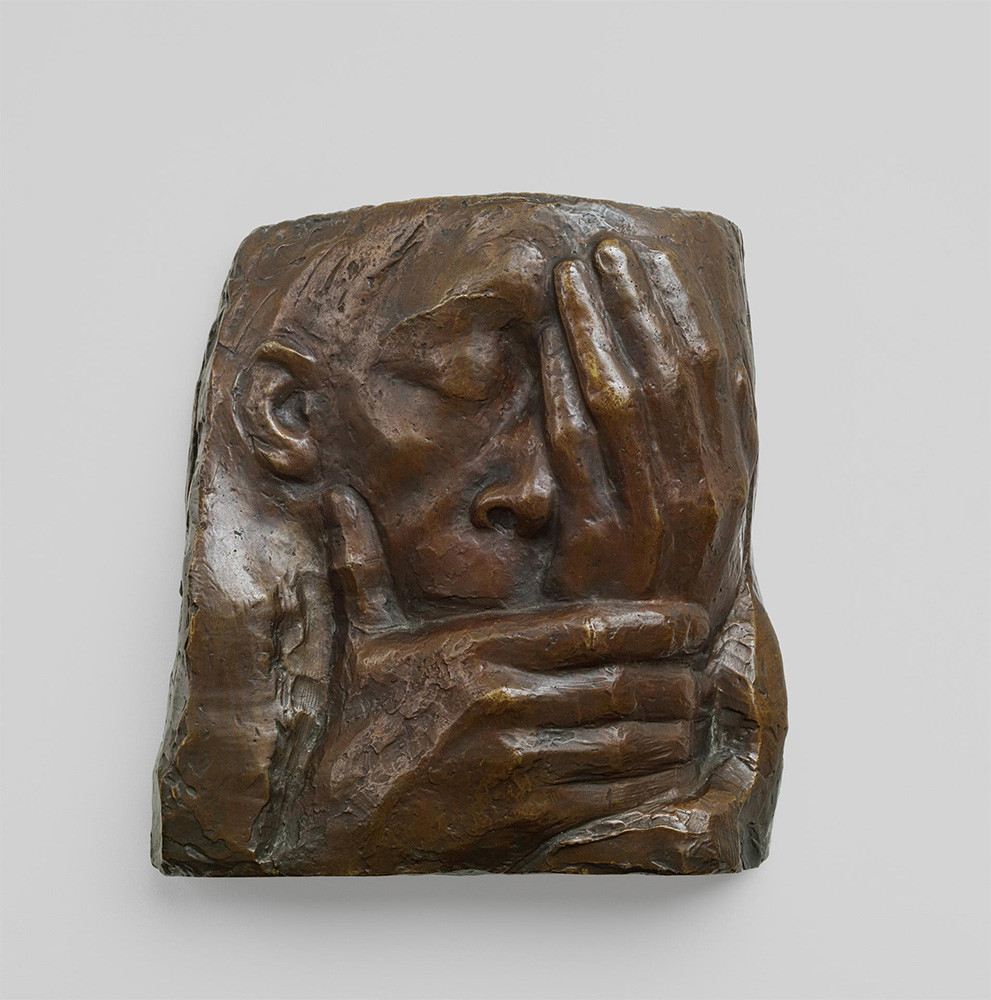
The first piece of work to tackle is the sculpture. This was baseda little on one of the bronze sculptures by Kollwitz. In contrast I am tackling it in air dried clay. The sculpture I included in the exhibition was in plaster. The image below shows the sculpture where I left it following Advanced Practice.
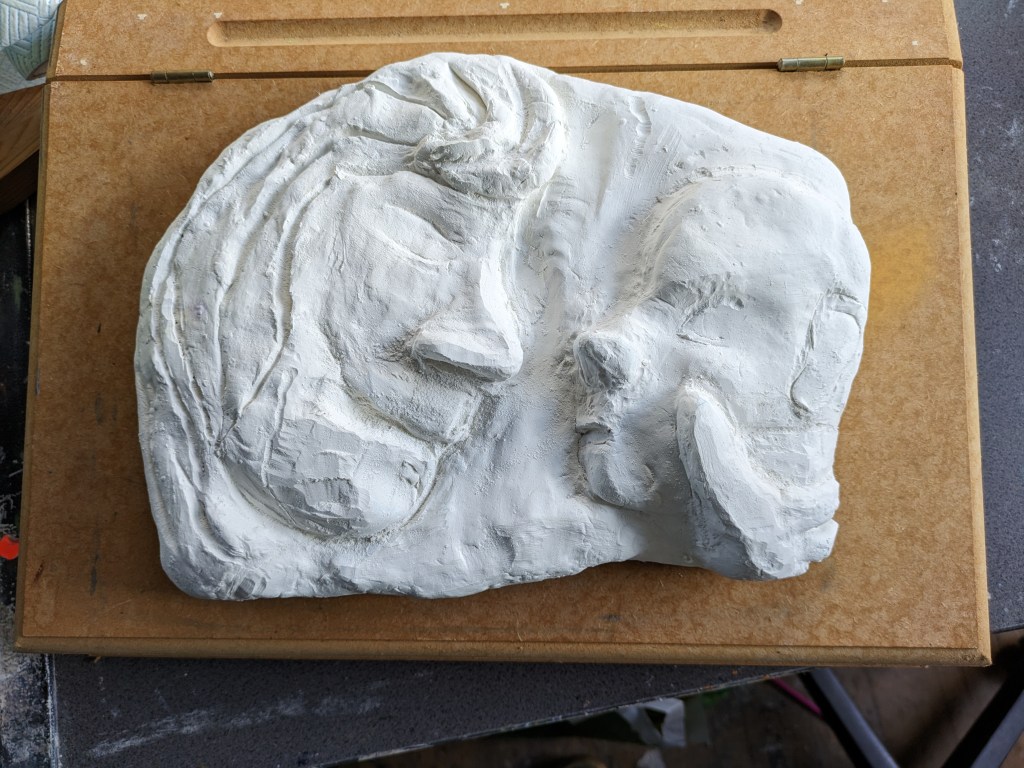
There is a lot of work to be done and as well as using small sculpture tools for carving I am using a Dremel tool. My hopes for this was to create mother and child in a gaze. I just loved this image by Kollwitz of her relief sculpture. I am trying to use the hand in my image as it holds the babies head. The simplicity in the very powerful bronze just exudes the grief stricken woman. My image doesn’t include much of the hand and the whole thing needs a lot of work but I don’t give up easily.
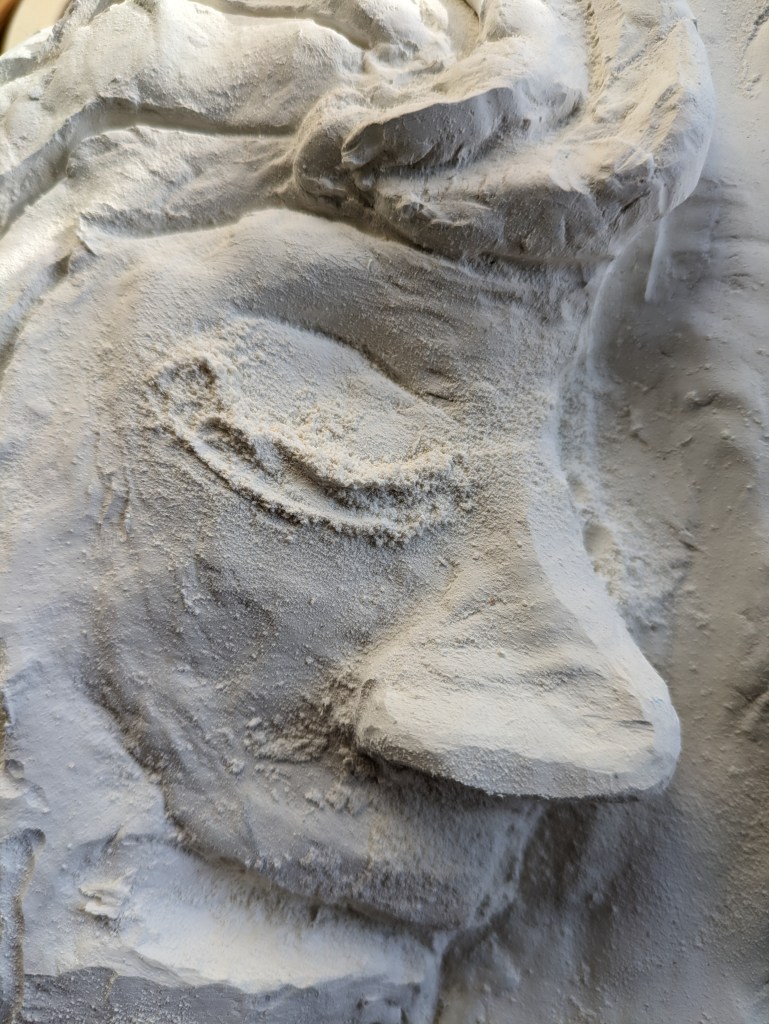
Today I work on the whole area of the sculpture. Mainly the hair and defining the woman’s face. I am trying to work back some of the features and to create more definition in the eye. The image below shows the close up of the woman’s eye.
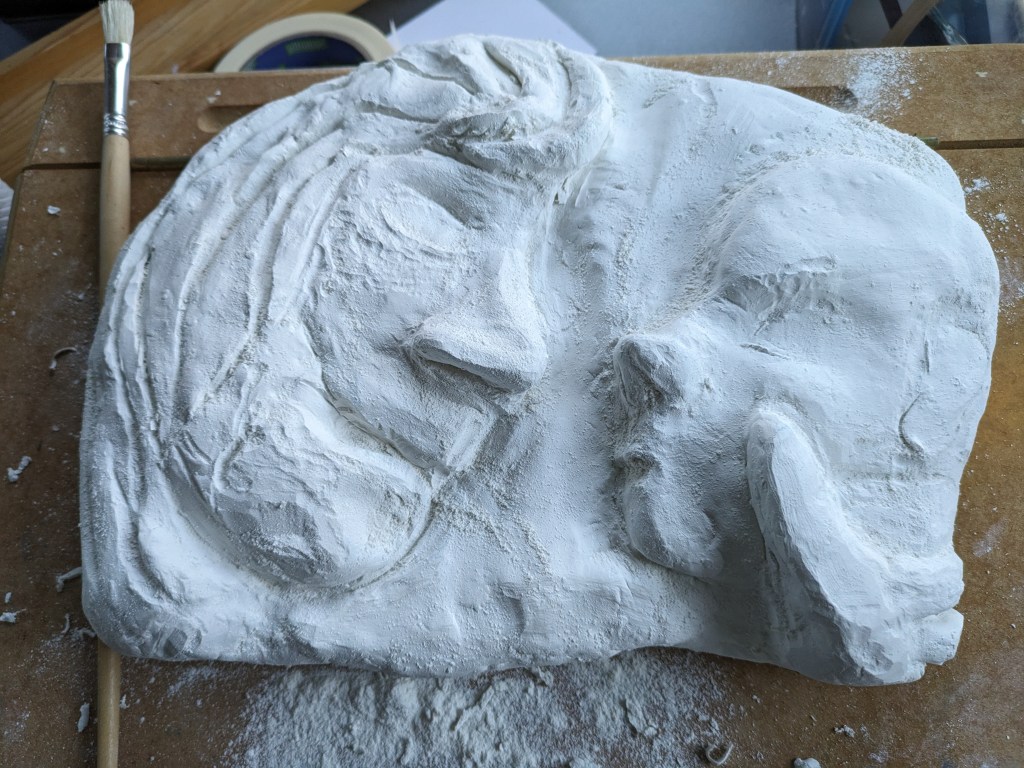
I keep working at the piece. Sculpture is also on my agenda to do more when I can. The next image although I have carved away quite a lot around the hair and face it doesn’t seem to have much impact yet. I leave it there for today.
I begin to research further appropriate children who have died. This child died at the hands of her mothers partner. She died on 1sy September 1984 and was aged one. 21months. I am trying to seek more historic cases and the image of this child was sourced from the Find my grave website.
As I start to draw I feel very saddened by the image. It’s not a very good one but I can see she is smiling. It is really important that I can capture this. As my reports and intentions indicate it is about celebrating their short lives and trying to depict them in a happy moment as well as raising awareness of the issues and failings of the systems and those within them.
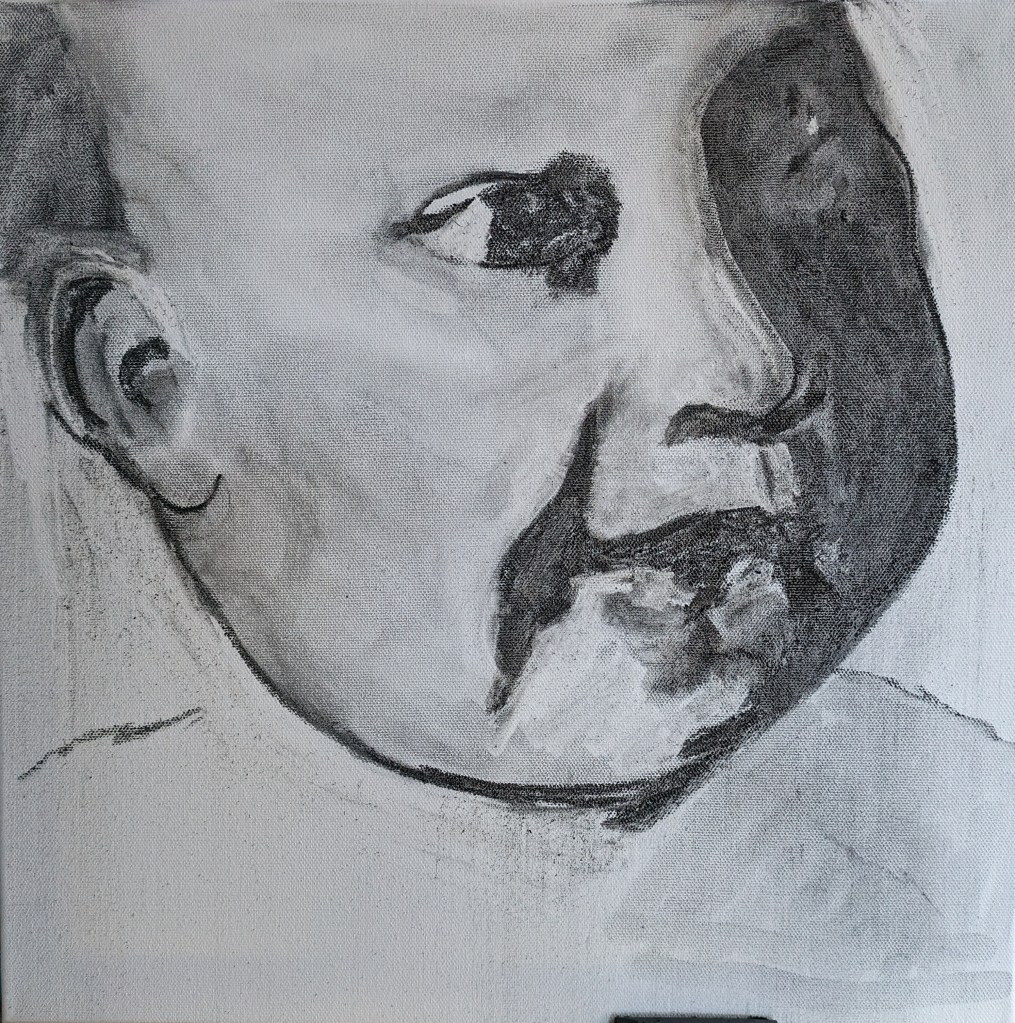
I don’t know if its because I have had such a break from these drawings but I do find it hard to draw well today. I start as I usually do by drawing a rough outline of the face and then I progress to blocking in the features. As previously, I’m working on a Windsor and Newton 16x16inch canvas. These permit rubbing in and out with the eraser well. Due to the poor image quality I am going to draw it mainly as it is with the face taking up most of the canvas. The one side of the face is in the dark and you can’t really see the features. My first marks are below.
At this stage I just concerned with the overall shapes and features of the face and observing well to put them in the right place. The ear is way too big and is not aligned correctly.
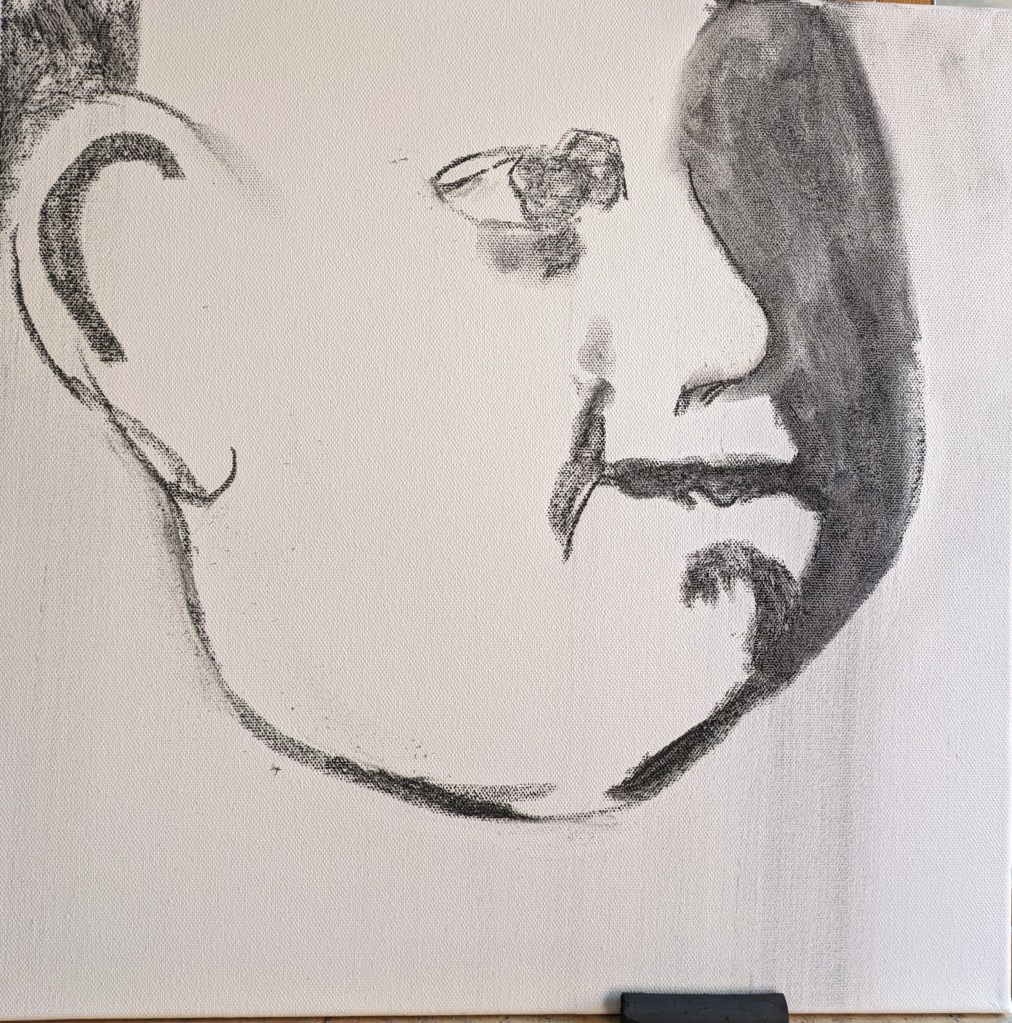
I refine the ear and I block in the darker shade on the right side of the face. At this stage although the right eye is indistinguishable in the photo I try to place it to see how it would look.
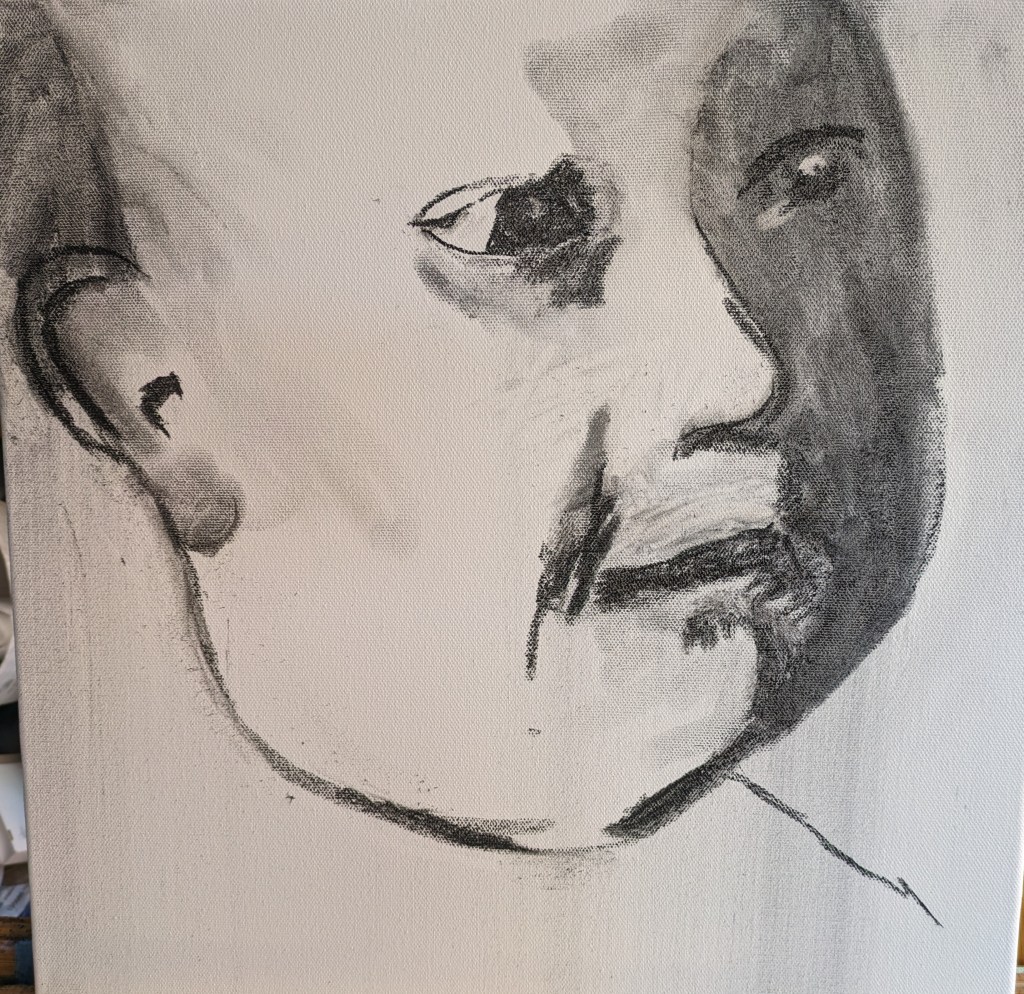
I keep working at the eyes and tring to block in all the dark and light shapes in the facial features particularly around the mouth and trying to detect the secret to her smile.
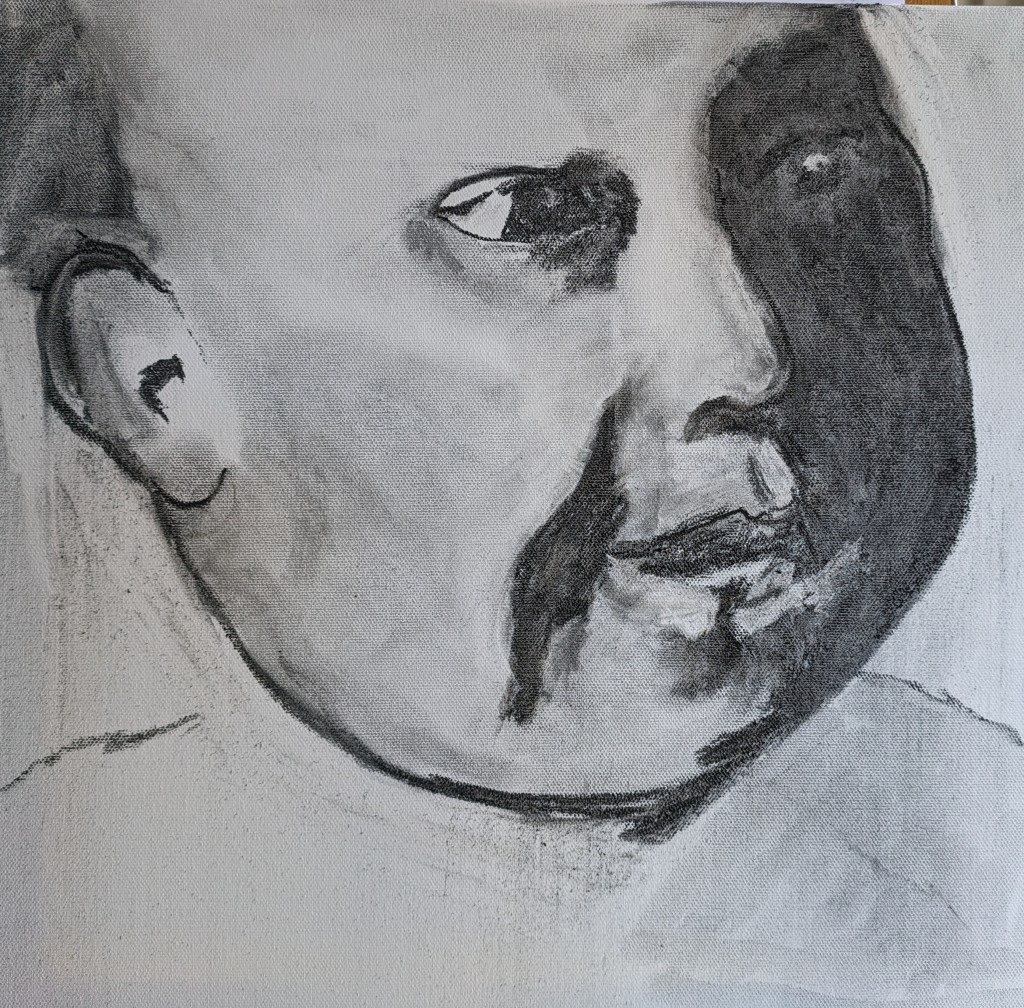
The image below shows how I keep working and reworking the lights and darks. The ear is better having reduced it in size. I do feel I’m struggling with this drawing. I was hoping that less of a phot might mean a better image. However I am determined to find the smile. There is a tiny glimmer here but the features are still not right. Observing well is key to the correct placement of all the features. Once these are accurately in place I can create the form in the facial plane with light and darker shading.
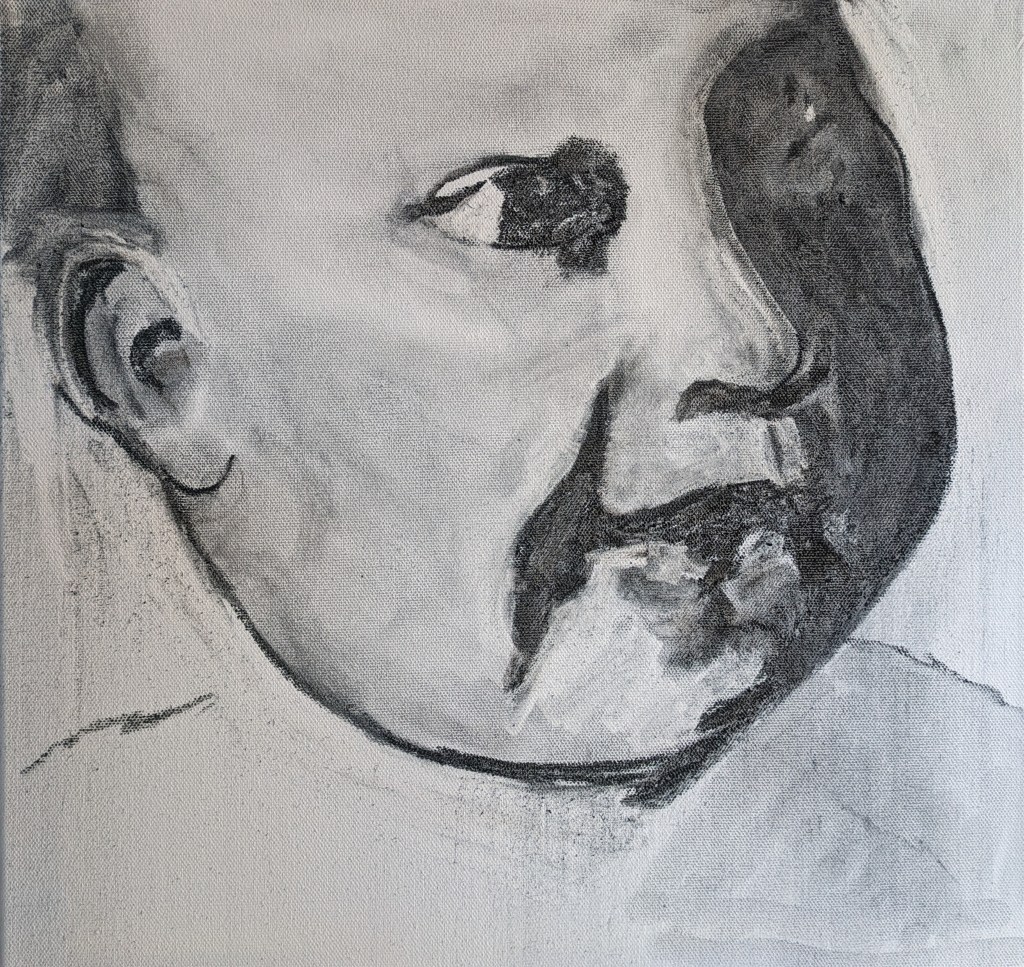
I keep working and reworking drawing and erasing around the mouth. The image below is a little closer to the smile but the features are still not right. I leave it there for fear of overworking and spoiling what I have. There is still a way to go but I feel its slowly getting there. The chin is a little more angular and I need to adjust this next time.
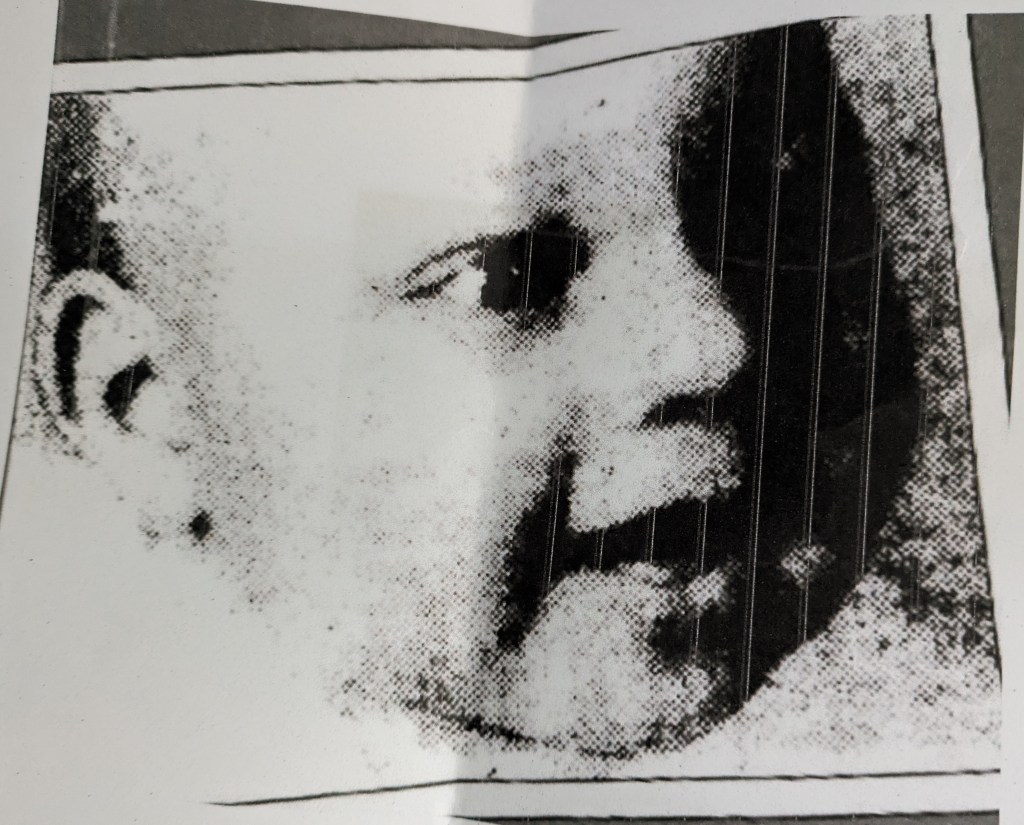
https://www.findagrave.com/memorial/217562186/tyra-henry
Find a Grave, database and images (https://www.findagrave.com/memorial/217562186/tyra-henry: accessed January 4, 2025), memorial page for Tyra Henry (8 Nov 1982–1 Sep 1984), Find a Grave Memorial ID 217562186; Cremated; Maintained by Lindsay Brown (contributor 47262939).
Project 4 Case Study, Lara Eggleton and Sarah Smizz in Conversation
Exercise 5 Watch Notice and Record
I watched the video of the conversation between the Artist and Health Professional Sarah Smizz and Lara Eggleton from OCA. It was really interesting to hear of the artists journey and how her illness sent her on another pathway into a career in health care. She spoke of resilience on many levels both as an individual and self care, the resilience of communities and how in many ways systems and the structures in society can dictate how resources and money is distributed. What resonated with me was her passion for life and to live it to the full. She is also using her art to make a difference to people and communities. This was more evident when I looked at her work and her blog. I had not come across her work before. I found her to be really inspiring in terms of my own project and how I might approach this. She could see as an insider in the NHS many gaps. In contrast to just the Health Service my project relates to many services that collectively have failed children. I’m talking Health, GP’s, Early Years, Education and Schools, teachers, Health Visitors, Police, Social Work and other support services. The artists knowledge of systems initially related to art and how some areas were lacking in resources. I need to check the demographics around the notion of exhibiting where I capture art and Health and Social Care Training courses. The artist is clearly making her mark and I’m sure I could learn a lot from her experiences in approaching people. What also resonated with me was the fact that she said her art has always been about care but it took her illness and re-training to really realise that and consolidate her practise. In this regard I felt an affinity as my route seems to have been similar but the other way round for example caring career then returning to it in art!
The conversation included the different support networks and communities that exist or that can be developed. She stated how important this has been for her to not feel isolated in what she does. I would have liked the opportunity to ask many questions. What has been important for me is the support and feedback I’ve had from close friends and health care professionals that have been very supportive of what I’m trying to achieve. I also enjoy the sessions we have with our Fine Art group. It is on my agenda to join Somerset Art Works and take part in Open Studio’s this year so I hope to develop more local links too. I am building this into my plan. Making links and connections is crucial at whatever level and can include funding opportunities too.
Having seen her work maybe I should be more expressive around the failings? I will build this into my plan.
Project 5 Communities of Care, Co-operation, Support and Creativity
Exercise 6 Mapping your communities of care.
I have already had such tremendous support both emotional support and offers of practical help in making the video. Having read numerous difficult enquiry reports which is hard going on the emotions when you read such tragic and horrific details of how children have died. The range of emotions from very deep sadness and empathy through to anger and frustration not just towards perpetrators but because these deaths could have been prevented. I have been very fortunate to have good friends and past colleagues who have not only understood my motivation but have provided encouragement and some consoling when necessary and at various junctures. I spoke yesterday to a past colleague and friend who gave me some very sound advice as I approach this nest stage. He is still in practice as a social worker and is freelance. He volunteered to help in any way and is also willing to be in the video. I was so encouraged again by his comments and really pleased to have him on board. Below I have made some spontaneous notes about mapping the work, different personnel and community resources to help me in my task and hope this will help towards my first draft plan. What is also important is the meeting with the Ethics Committee and the Outcome.
The first diagram covers notes on the overall plan and resources.
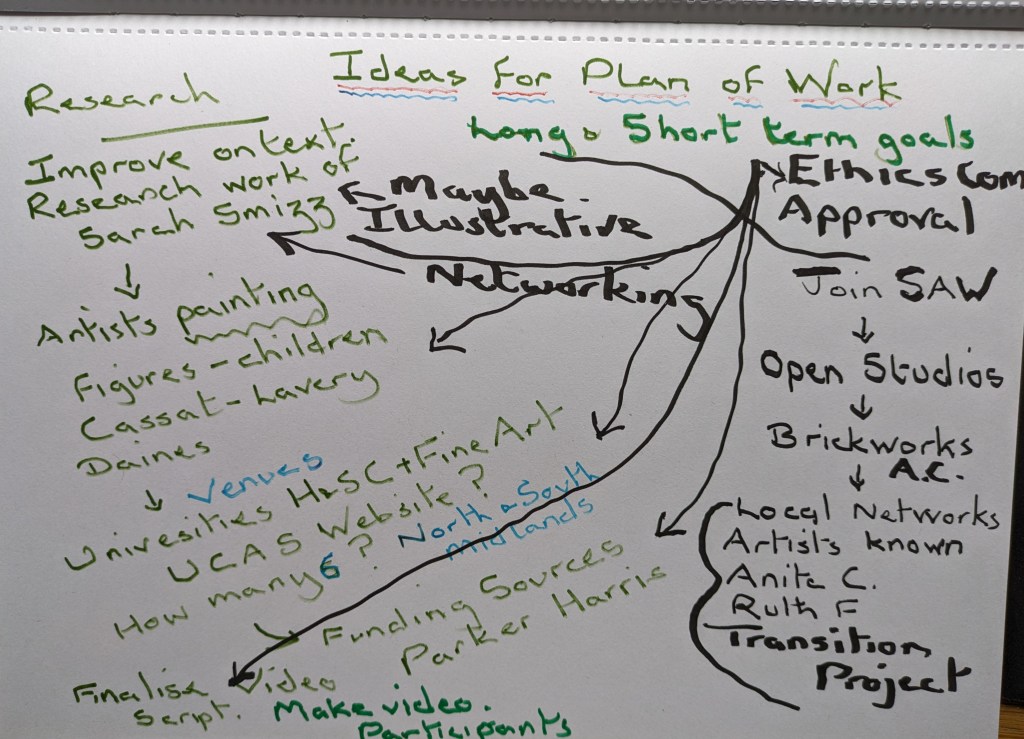
The first textual diagram includes most of the work to be addressed. It includes new learning and research and some short term goals and long term for when my first project will be concluded. I’ve included on the right two local artists who are very prominent in the local area/community and who I hope to work with on projects in the future. One has exhibited in the National Gallery, London.
The second image below includes the possible venues I would like to see the work exhibited. I have met the curator of Bournemouth Uni when my drawing toured there with The Trinity Buoy Wharf exhibition.
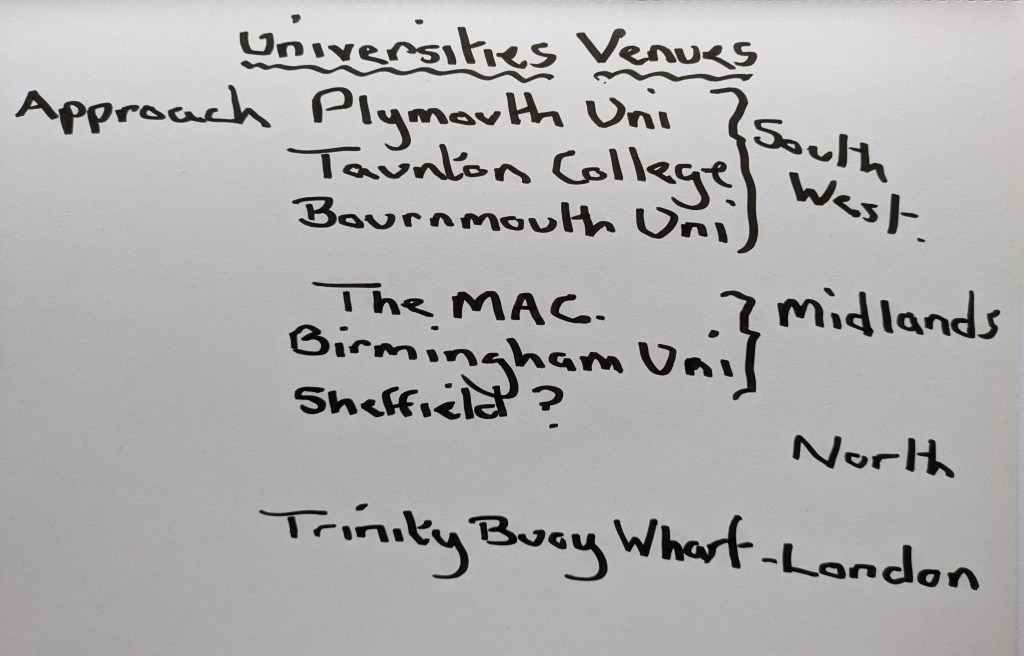
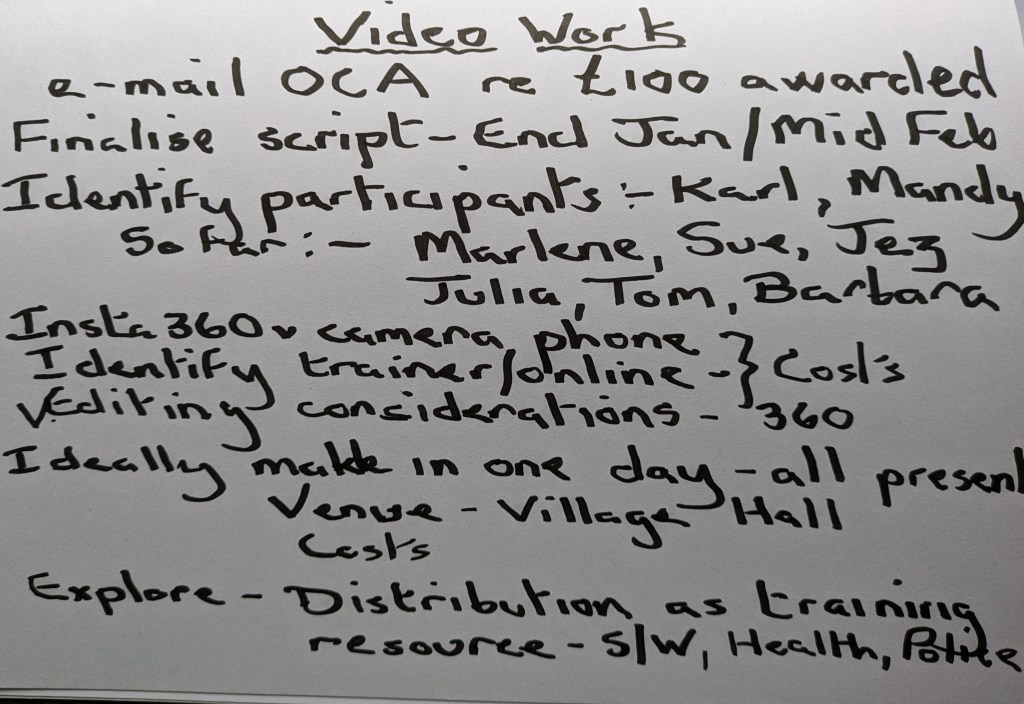
The sheet above includes resource participants in the video. They have all had Teaching and Health and Social Care roles apart from one who is an artist and created a very powerful book about mental health and grief. My main focus as soon as I can is to complete the script and skill up around making the video.
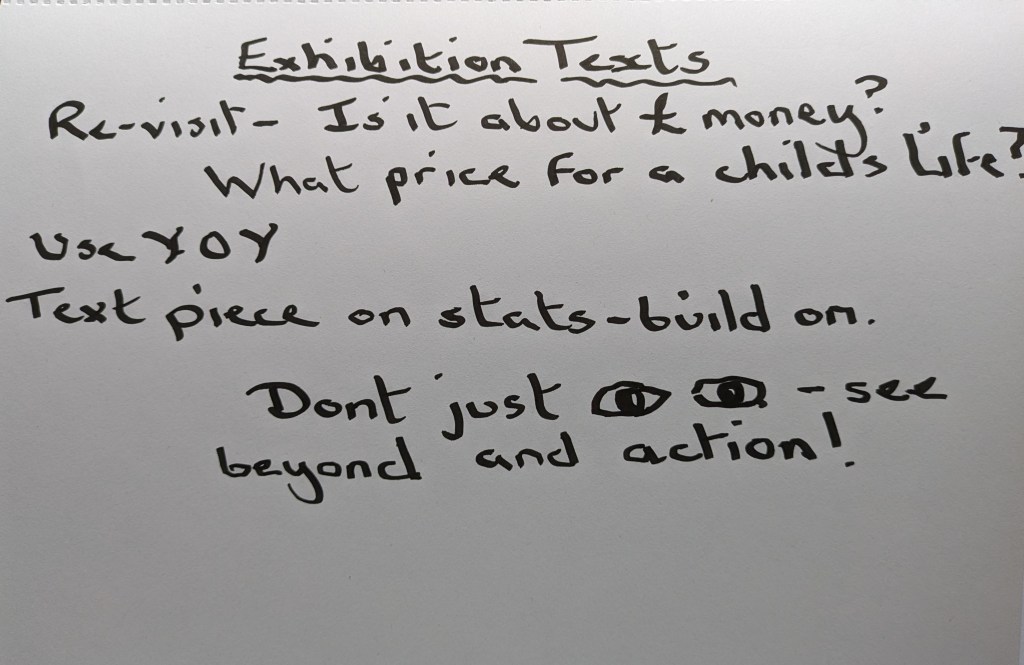
The last page includes reworking and adding to my original textual work in the exhibition. Since following and being introduced to Sarah Smizz by OCA in this part of the course I am very keen to ellaborate on the texts and include one or two examples that will go into the exhibition.
I have really good ideas about getting the project out there and gaining momentum through social media but I do want to have the support of the ethics committee. At the moment I don’t feel I can celebrate my project and recent exhibition. It feels like my hands are tied and I shall manage progression very sensitively and hopefully start with positive approaches to those who train the various personnel.
Exercise 7 Skills and Networks
I believe I have covered this in my map notes but my main issue is developing knowledge of funding providers. I am going to approach Parker Harris to see if I might be eligible for the Elizabeth Rawlings award. I need to research further for other providers. Michele Whiting gave me some sources to check. Art Council England might be an option but may be too long winded!
My other issue is to develop skills in video use. There is a teacher who has suggested someone that my help but I need to explore this further and the cost.
 Art for the power of good