Project 1 Driven by practice.
Exercise 1 Time for Making
Finding time on some days can be a bit difficult but I am quite disciplined and have learned to manage my work in bite sized chunks. Over the last year or so and for the purposes of developing my body of work I have mainly worked in charcoal and a little in pastel. I am learning more and more about pastel and for the SYP I am really excited about also returning to oil paints. Bite sized chunks means that I will usually have an idea in mind about what I want to achieve. I am not over ambitious and this means I am not disappointed if I do not finish what I expected to do. What is clear and beneficial is that all my work must be based on research, whether this is a particular topic such as the deaths of children or the research of other artists, their materials and techniques, palette etc. I plan to build on my body of work and to undertake one or two more portraits of real children who died but to also do a few works in a combination of oil paint and pastels. These will be of children but more saleable work. When working, I sometimes have two or three works on the go and its nice to return to them at different junctures. I never suffer from what to do or artists block. I am never short of ideas. If anything, I have too many and sometimes hone down on them. I did this with my recent exhibition and shelved the making of the video until the exhibition had had its first airing. I guess I have become an activist. I believe that you only must look around you locally or hear the news/media to see some important or significant topics. The other sources of information that inspire me is visiting galleries and browsing through my various books and journals on art both hard copies and online. Palette plan, materials, colours, and techniques are so important and integral to suiting your topic and to the success of the work. In this regard I will usually rework and rework until I resolve a creation.
I reflect on the work at each stage. From the first plan for the work and the choice of materials, surface and colour palette, the outline of a portrait, to refining the lines, blocking in the features and facial planes, any background. Sometimes I will work on the face and the body before moving on to the background and at other times I might work on both at the same time. I can usually work on two or three works in my studio at any one time. (I have also cleared some space now in my garage. This will facilitate workshops for the future and to undertake Somerset Art Weeks in September.) Sometimes putting in the background particularly if it is a dark colour can really make the portrait stand out. It is magical as the painting comes together. Sometimes it is good to leave a work and come back to it the next day as you see things through different eyes, fresh and you see things differently or things you had not considered. Reflection is part of the process. I really feel confident now that I manage my time and my commitment to my art well. I usually spend half days, an hour or two or full days in the studio. Seven minutes would only be for reflection and I do that each session. On POP 2 when we were considering materiality I made a chart out of the letters in the word and the words artistic definition. One of the scenarios from Derrida is that when complete the work should sing. I love this concept and I keep the chart hanging in my studio for reference. I have learned such a lot and I know that this learning can be built on and will help me in the future. I work mainly in the day on practical work due to better lighting. Although my studio is outside, I have lighting and electric and a heater. I usually work on written work, research, or blogs indoors and in the evenings. It is important to document the progress of work and new discoveries. This can be a bit tricky if covered in paint and I must improve on this when I get to do new work in oil and pastel.
Self-reflection Task What works for you?
What I find most helpful and nurturing is walking in our beautiful rugged and raw landscape. It not only feeds the soul and is quite spiritual but it is so inspiring. The sea and our fabulous coastal paths and beach walks are also a very rich source of almost meditative replenishment. While I can walk well at present and my energy levels are okay as I get older, I do worry about sustaining good health.
Exercise 2
That Bright Grey Eye
By Hilda Morley
The grey sky, lighter & darker greys,
lights between & delicate
lavenders also
blue-greys in smaller strokes,
& swashes
of mauve-grey on the Hudson—
openings
of light to the blue oblong
off-center
where the door to the warehouse
shows—
the larger smearings darkening
deep
into blues
So alight that sky,
late August,
early evening,
I had to
gasp at it,
stand there hardly moving
to breathe it, using
whatever my body gave me,
at
that moment attending to it,
thinking:
Turner, he should have
seen it,
he would have given it
back to us,
not let it die away
And that other
evening, walking down Bank Street from marketing,
the sky fiery over the river,
luminous but
hot in its flowering also,
rich in color
as Venice seen by Guardi—more aflame even,
the sky moving in a pulse,
its fire breathing
in a pulse verging on danger—mane of a lioness
affronted.
That brilliance—the eye of the lion
filled to the lids with
flame
And his eyes, Turner’s, that bright grey eye
at seventy-six,
“brilliant as
the eye of a child”
who grew his thumbnail
in the shape of an eagle’s claw,
the better
to use it in painting
In Kirby Lonsdale, Yorkshire,
where Turner first drew mountain-landscapes,
I found Blake’s Marriage
of Heaven and Hell—sold for two guineas, 1821
& Turner aged 46 that year
& there I read:
“And when thou seest
an Eagle, thou seest a portion of genius.
Lift up
thy head,” says Blake.
These afternoons now,
late in September, 76,
the sky, the river are lit up
at the end of Bank Street, at Bethune.
The pavement
trembles with light pouring
upon it
We are held in it.
We smile.
I hold my breath to see if
the cashier in the supermarket
will be gentle with the old lady who cannot
read the price-tag on
a loaf of bread.
Then I breathe freely,
for yes, she is helpful, yes, she is
kind.
Outside on
the pavement, the light pouring itself away
is the light in the eagle’s
eye (or the eye of
a child)
(I saw it in a man’s eye once:
but he’s dead now more than
four years)
Drawing heat out of
surfaces,
the light is
without calculation,
is a munificence now,
is justified.
new york, 1977
Copyright Credit: Hilda Morley, “That Bright Grey Eye ” from To Hold in My Hand: Selected Poems, 1955-1983. Copyright © 1983 by Hilda Morley. Reprinted by permission of The Sheep Meadow Press.
Source: To Hold in My Hand: Selected Poems, 1955-1983 (The Sheep Meadow Press, 1983)
The drawing I make for this exercise is still about the preciousness of life so in some ways its relative to my project. The sentence from the poem that I choose is That moment attending to it. The scene is of a swan on the nest. I recently reflected on a lot of photos I take with the intention of creating paintings. I couldn’t help undertaking this image of the swan. I took the photo on a visit to the Swannery in Dorset. A lot of the signets were already hatched. The photo is below.
I decided on pastel and completed it on a 50×70 piece of velour. I’m still getting used to this medium but I’m really liking as I do with the charcoal the spontaneity and immediacy of the work as it unfolds. Below is the different stages. Its hard to do many photos as hands are very messy.
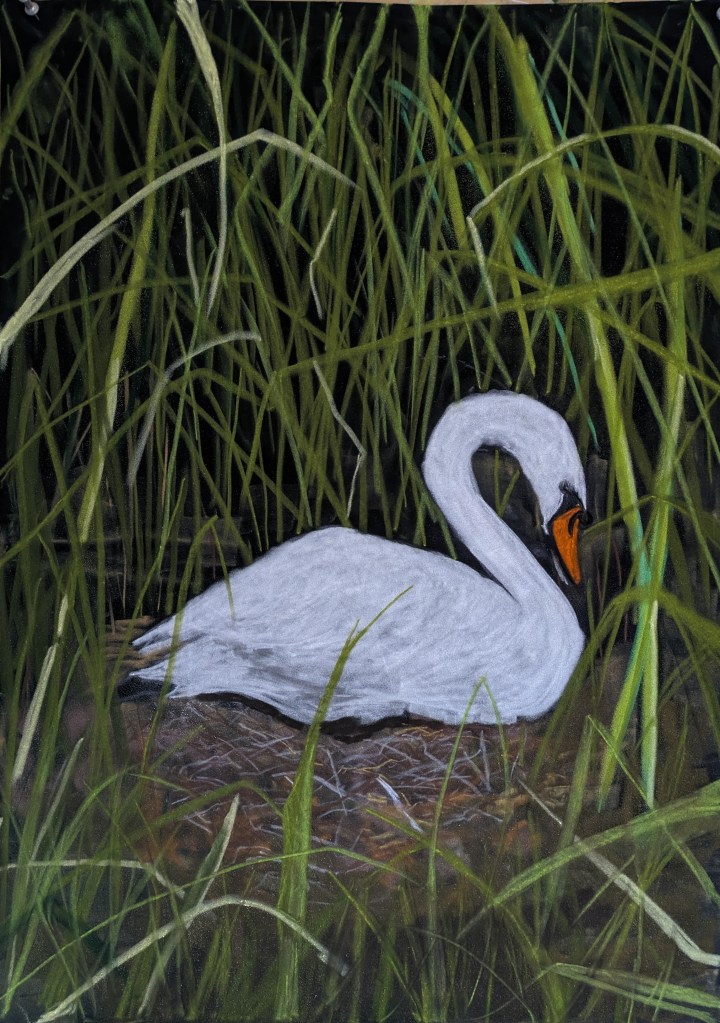
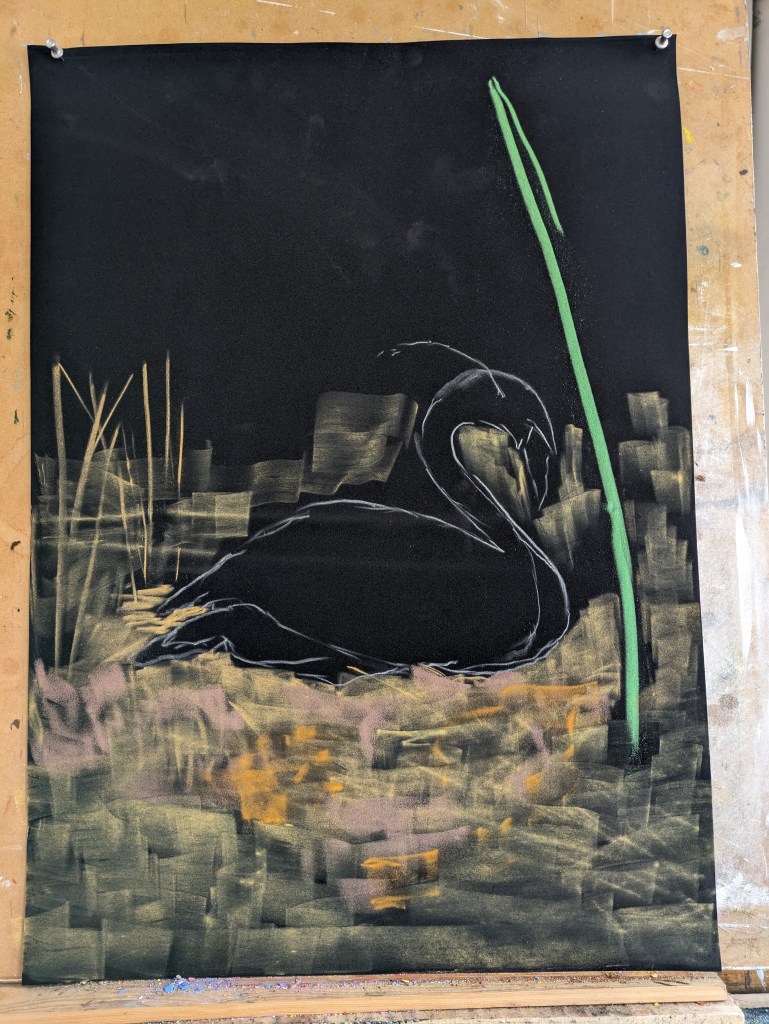
I’m having a bit of trouble with resizing photos. The top image progressed from the bottom one. There’s just one or two fine details to complete and then I hope I’ve done this beautiful swan justice.
Project 2: Artist Support Structures
Research Task: Local Contexts
Its good to reflect on my existing sources and knowledge of local resources and opportunities.
I already have knowledge of a number of artists who I could potentially try to join forces with in the future. These links I have are some students I know through OCA and those who I have developed links with through undertaking my three exhibitions. The Transition Town that I raised money for have a group of artists that meet regularly so at some point I may join the group. I took part in the OSMOSIS exhibition with OCA students in 2019 and have recently reacquainted myself with the members of that group. However my current project is one that I need to complete on my own. I was introduced to Visual Arts South West by one of my previous tutors and this I hope to be very useful with opportunities for artists. I keep an eye on the website as it has really useful information. As already indicated in my plan I hope to take part in Open Studios later in September this year and have plans to join S.A.W. I have taken part in the past with two other artists and it was a great opportunity. Since one of my drawings was in the Trinity Buoy Wharf exhibition 2023 I have kept all links to Parker Harris who manage a lot of online resources and various open calls. I shall enter these as appropriate and when I can. Hauser and Wirth Gallery in Bruton is also on my agenda to visit and if appropriate make an approach to in the future. They are internationally renowned. I do believe I have already done a lot of networking and am always researching via the internet different resources and opportunities. Other students work and visiting galleries is very inspiring.
Its the 11th February 2025 and today I received an email from the Ethics Committee, Christian Lloyd. They are happy for me to proceed and were appreciative of my detailed evaluation of my exhibition. They did not consider it necessary to meet with me so I am very relieved and spurred on now I can move forward. As a result I have joined SAW today as there is a resource I can tap into and explore about film making.
Exercise 3 Small Opportunities
I have already been doing different kinds of exhibitions locally such as the two POP up Shops I undertook for charity in the past two-three years. These were a great success and I ran several workshops too. SAW covers the South West and stand for Somerset Art Works. I have joined the organisation today 11/2/25. It has some fabulous resources and opportunities for residencies. I will keep my eye on these. I am going to approach next week a resource that makes films. I hope to meet to discuss hoe they might help me make the video and skill me up!
15/2/25 In light of me being able to proceed I have set up a profile today on Arts Council England. It takes a few days for them to process basic details before they agree for you to make an application. I will need to be busy costing the project for it to tour. I also joined today A-N Artists and it was free to join as a student. The website is very resourceful and offers webinars on funding and grant applications. Although this intake is fully subscribed I managed to find some video replays on the site from last year. There is some good information in the videos and I will make use of what I learn in making my application. Now I have a positive response from the ethics committee I shall forward some details to the OCA ZINE. The third thing I undertook today was to watch the free Parker Harris Art Ladder videos. There is a link to enquire about the possibility of mentoring. I shall email them soon to enquire about a one off session. If I can talk to someone I can check out the use of TBW and might they help with the project touring. Having made a link with Alison Cosserat at the Brickworks Gallery I will also, once the project has toured and Open Studios are complete I will undertake another exhibition locally. It will also be good to undertake different subjects.
As I reflect on my options most of them help raise my profile but the project Silent Voices isn’t about me its about what happened to these children. This keeps me well grounded. I think that all of the options I have including Instagram are likely to be great options if they can be managed well and sensitively. Unlike artists who are often not present at exhibitions I plan to be there and deliver some understanding and more insight about the project. Approaching an agency like PH is a bit of an unknown quantity. They do help artists but I must be mindful of any commercial value for them.
Research Task OCA Peer Groups
I’m always appreciative of the groups I belong to with OCA. My small Fine Art Cohort is about eight or ten strong and its a really skillful and diverse group of people that really enrich discussions and art related matters. They are also a good source of support and advice. The second group which I have rejoined is more diverse and quite a large group. Its led by Anna Goodchild who features in our SYP manual.
Exercise 4 Continue developing and refining your own work
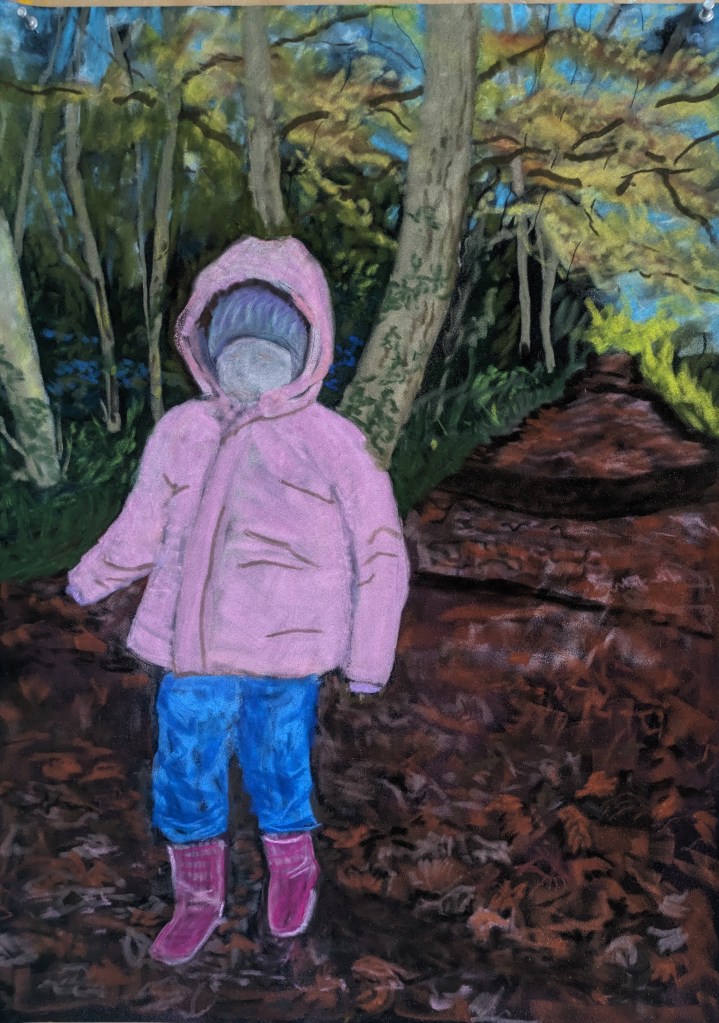
The ongoing work is in this section. I have been drawing again in pastel. Its like an extension to how at ease I have been with the charcoal. I’m still undertaking research on other specific artists to support my work. see research section. I begin another child image from a photo of my friends child. Its 40×70 cm on velour. I start to sketch in the shapes of trees, the pathway of leaves and the outline of the figure. With this medium and the fact that the background is black it is easy to cover up in colour and either blend in another colour or colour over the first one. I work on all areas quickly for accuracy and just keep changing my colours. The face I will leave mainly till last.
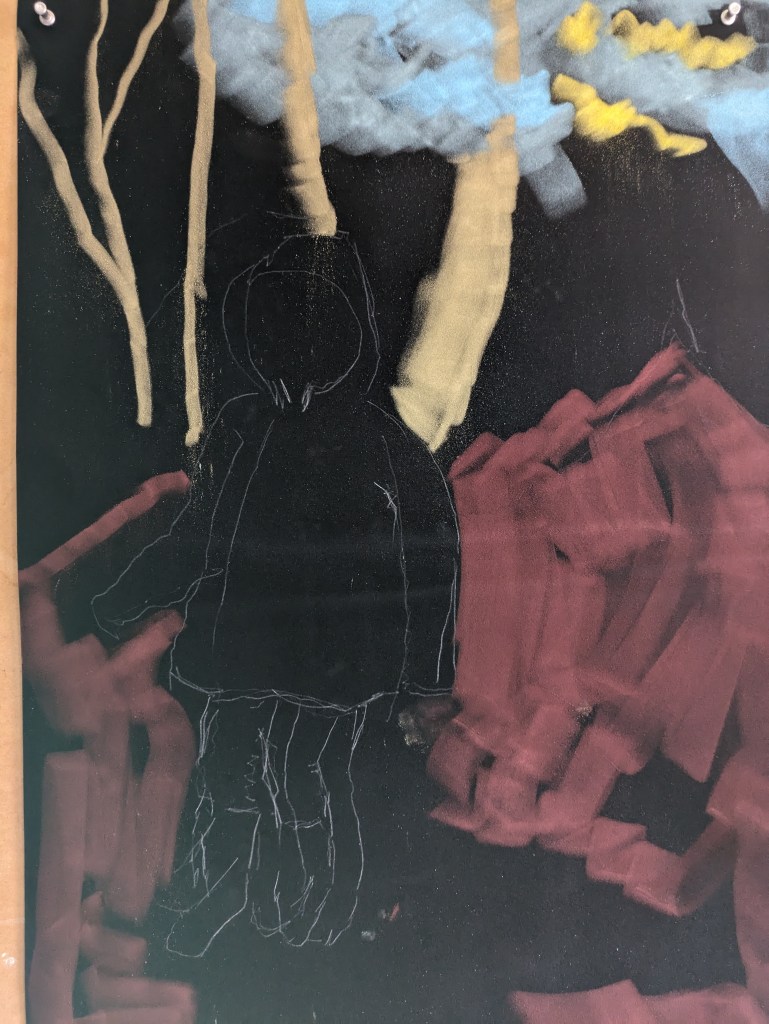
The image below shows how I experiment as I proceed. I’ve thrown all similar colours as in the photo image but I’m not sure about the colours and whether they compliment each other well enough. As you can see the composition is okay and I do like it but I need to ensure I create a foreground middle distance and a recessive background. The pastel as I stated is easy to play around with and adjust colours. If you rub in you can then rub off and lay in new colour. All areas will need building up more and refining.
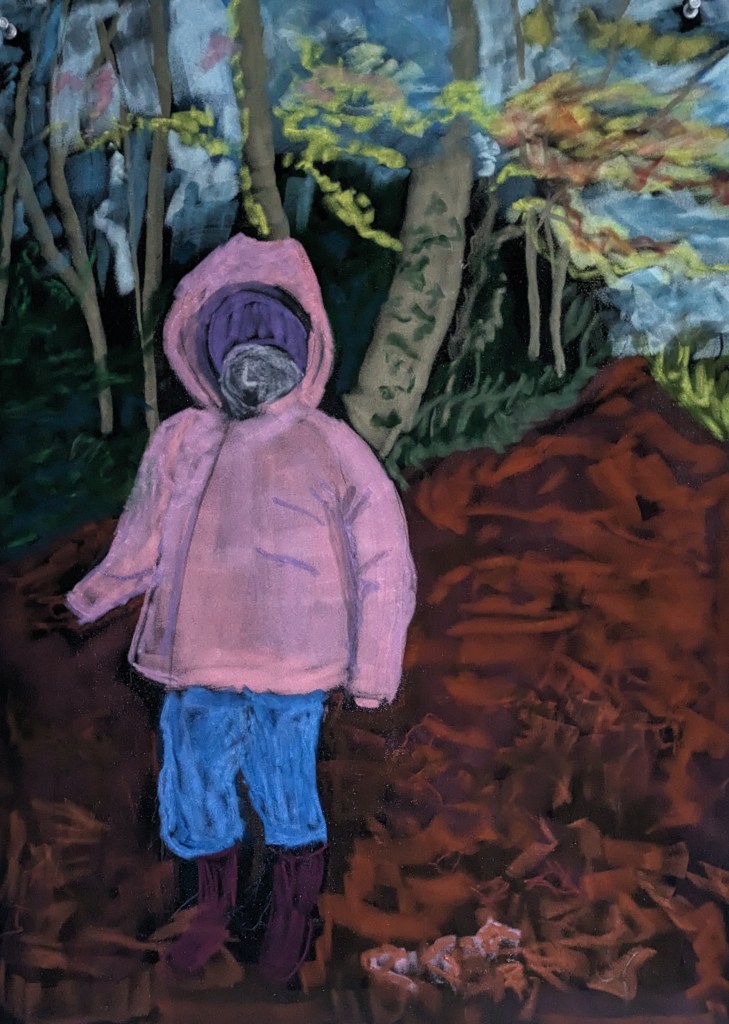
The next image shows how the work is beginning to take better shape. I work all areas still at great speed but leave time after working each area to stand back and reflect. I worked the pathway a lot trying to get the right colours in the leaves. Although more of a dull brown on the photo I quite liked the use of harmonising with a little of the pink colour in the jacket. The other area I struggled with a little was the background leaves on the trees and the recession. I tried to damp these down a little and as soon as I put in more branches it seemed to work better. I put in some blue in the wooded area to depict some bluebells and I put some ivy and leaf growth on the trees. The large tree is at an angle and looks bendy so I tried to bend my shadow of it. Some poetic license here as my photo has no shadows.
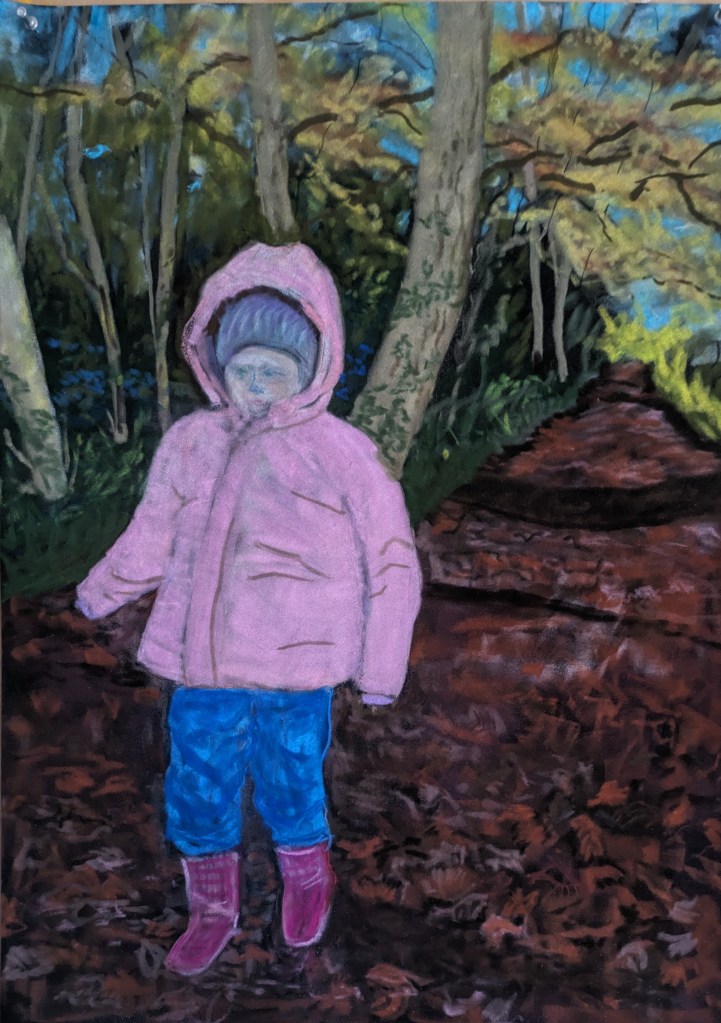
The image above shows how I’m not far off completion. I work a little on the face and adjust the right leg a little. I quite like the leaf shapes and shadows. I need to put in her hands although they could be tucked up her sleeves for warmth. I leave it there for today.
Research Task Creative Conversations
I listened to two of the podcasts today Anthony Gormley with Roddy Doyle. I have always been a fan of Gormley’s work how his work really awakens our emotions. You can feel the loneliness, serenity or isolation of his figures. Both shared some of their processes and reflected on life and form. Both commented on Gormley’s Angel of the North and it was an immense undertaking. He made reference to the huge ship panels of steel and the huge number of people involved in building and erecting it. Gormley commented on how his main tool that he always carries with him is his pocket sketchbook. In contrast Doyle dispensed with pen and paper and always uses his laptop. It was great to hear Gormley state that all his work he considered as experimentation. I feel very similarly to him as I embark on each drawing. He went further describing how excited he always is about a new work and that he is less anxious about his projects in the here and now. Again I feel very similar in as much as I produce better work when less stressed and relaxed. Doyle made reference to how he proof reads before submitting work and that that is an anxious time. Its the last chance to make any adjustments. I do think it is sometimes difficult to know when a work is complete. If in doubt I always stop and return to it with fresh eyes the next day.
The next podcast I chose was Helen Cammock and Suhayla El Bushra. It was interesting to find that both of these artists knew of each other from a social work background. Similarly to myself they both reflected on some of their past experiences and this was evident in their work. Listening to these woman really resonated with me in terms of where I am heading. Our past experiences both good and bad make us who and what we are and also what we might aspire to. When I was working in difficult times the Prayer of Serenity was always helpful and kept me grounded. Even if you are not religious the words were very sound. I always kept a copy of the prayer in my diary/filofax. I don’t think I have forgotten it……
God give me the grace to accept the things I cannot change,
The courage to change the things I can,
and the wisdom to know the difference.
Its really odd that this has cropped up in my thoughts now but I guess this work is potentially about what I can change. I do hope I have the courage to see it through.
Research task Participating in a Crit
I am very familiar with the Artquest website and have undertaken feedback from peers and have taken part in the OCA Crit sessions. Having just completed a thorough report for the ethics committee which included lots of comments and feedback from the public who came to my exhibition, I really feel confident that my work will always be ethically sound. I already completed the Future Learn course about ethics. The Artquest website is also a great source of information. As I move forward towards making the video I am going to explore the licensing of a video and how I protect it from being copied or used without permissions. On 20th February I met with a representative from Somerset Film. They are based in Bridgwater and are a charity. It was a fabulous meeting. I went along to their venue which also houses studios and a cafe. The organisation is a charity and gets funding from the Arts Council. They also work with adults and children with learning disabilities. I took all my possible equipment, camera phone, Insta 360 and laptop with camera etc. As I’m not making much movement in the film he suggested that my phone was very good and I just needed a pixel7a tripod attachment. He really appreciated my project and what I am trying to do. I mentioned how the OCA had given me some funding of £100 and that I planned to seek more for the video participant to be given some expenses and payment if possible plus for the costs of the exhibition to tour. Following discussion he agreed my best option as I was keen to undertake the making of the film myself was to have a couple of sessions with one of their experts called Dan. He could help skill me up. I was able to look at the studio, lighting and sound plus an auto q facility. It was a very productive meeting and he agreed to send me costings in the next few days. I receved my verification details from the Arts Council so as soon as I receive info from Kevin Redpath I can start on the application.
Exercise 5 The Group Crit and Working with Peers
Participating in group crits and working with peers is so important on many levels. I meet regularly with my peers online and it has been grat to have their valuable feedback. It is also good to see how each of them have grown and have diversified in their work over time. The other benefit I had recently was my exhibition feedback. It took a lot of courage to go through with my exhibition as I never feel that my work is good enough. The children and their portraits compelled me to carry on. The feedback from the exhibition however was complimentry not just about what I was doing but people spoke well of the images I had created. I shall make good use of any opportunities.
Exercise 6 Part 1 Follow up 1 week to 4 weeks
This exercise ask what is going well with the making. I have not had a s much time as I would like to make work and finish off some but I feel comfortable with the stage I am at. Now that the ethics of my project has met with approval it i vital that I complete the script for the video so a lot of my energy is going into that. Even if I don’t put any more visual images into the exhibition I am happy with what I’ve got and what I did, however I am slowly progressing and do have the time to go at my own pace but for the course requirements.
Research task Ten Practitioners
My ten artists are those that I have admired, gained a lot from and have been able to often put into practice what I have learned from them.
My first three are William Kentridge, Kathe Kollwitz and Barbara Walker. Each of these artists have given me the skills and confidence to draw and improve my practice. They all use charcoal as one of their main mediums and I learned from studying their practice how easily and malleable the medium is to use. My visit to the Royal Academy in London to see Kentridge’s work was just such a cathartic experience. Barbara Walker was one of the judges who was involved in choosing my drawing for the Trinity Buoy Wharf Exhibition. It was such an exhilarating and yet humbling experience to be part of that. WOW!
I must mention others that gave me some encouragement to draw such as Seurat and his charcoals. I must include the work of Hopper too. I loved his ability to make us feel his work, the isolation of a lone figure and his fabulous use of light both in his indoor work and outdoors. Again I saw some of his work close up at the Ashmolean in Oxford. What I remember was that some of his lines were not perfect in regard to the buildings. When it comes to paint I often use the palette knife and I love the impressionist work of Van Gogh and Monet. They along with the modern day impressionist such as Daines helps me to paint figures and portraits in oils. The other artist I shall mention is a fellow student. I don’t think I would have branched out to working with pastels if it hadn’t been for Felicity Talman. Her work is exquisite and executed with such great detail. I’m testing out very different surfaces and they seem to be working for me. I guess the pastel is an extension to the charcoal I’ve been using. I am currently researching Mary Cassat and her pastel and oil portraits and figurative work of children. I love her use of pastel and building up lyers of colour. If I was to have a conversation with the first three artists each of them has been a good advocate addressing social issues and been politically driven. Kentridge and Walker are still alive and my conversation would have to be initially to thank them for not just the skills they have imparted to me but they have helped me to realise that I am an activist and like they have been able to be a great advocaat for others and to affect some change, I hope that my work may touch some people too.
Project 4 A cultural ecology
Exercise 7 Cultural ecology?
I read the Kerry Harker article and was also reminded of the Sarah Smizz discussion that took place online. When I consider these issues in relation to artists and art its clear that there are some very marginalised artists who are really struggling to be heard, funded and valued. Its like a postcode lottery when it comes to who gets what and artists in some areas have a better chance of surviving and making a difference depending on their work. As I read the document The cultural and eco-systems of creative people and places there is clearly a lot to digest. However I fully appreciate and understand the importance of creating a much more cohesive and effective management of resources and their equitable distribution. There are such a lot of communities that really benefit from the arts and those with the purse strings are seldom in touch with what goes on at the coal face or the grass roots level. When I visited Somerset Film I was informed by Kevin Redpath how his organisation was funded by the Arts Council and that they undertook a lot of wok with adults with learning difficulties. I could see the huge benefits for the young adults I saw to participate in the activities, grow in confidence and to improve their own social network and skills. What concerns me is those in power that allot the funding and the arts is always considered as almost a luxury we can do without. These more social and political issues I shall definitely give more thought to after the course. For me personally and the area I live in there is a lot going for artists and there is the potential for me to integrate more and build up more people resources. However what I must realise is that my project needs to tour in the more deprived cities and towns where children are more likely to die. If I apply for funding I must really make a strong case for community engagement and the benefits of my project to improve children’s lives. A couple of the reports I considered in my research show the demographics of where the children are dying and I will return to this report to target areas based on the needs there.
 Art for the power of good